Procedures and procedures for making investment projects in residential areas and urban areas
Many customers want to implement investment projects in residential areas and urban areas, but do not understand the process and procedures. Today vietduan.com will introduce to you the most accurate and standard process of making land investment projects.
Step 1: First, you must have land, a land area to do investment projects in residential areas and urban areas.
Normally, with investment projects in residential areas, urban areas will be built on agricultural land (rice land, land for perennial crops, land for production forests) because the compensation cost will be much lower than residential land. (also known as residential land), through which it is easy to profit and bring a lot of profit to investors.
To obtain land for a project, the investor must go through a number of forms such as:
The most common is that they previously bought and collected a number of adjacent land lots, then applied for approval of the investment policy.
Implement investment procedures from the step of applying for approval of investment policy and approving investors through bidding to select investors (for projects when the land is not yet owned by the investor).
To be allocated land by the State for the construction of land plots (residential areas).
Obtained through auction: Usually in a locality that has a land plot that wants to establish an investment project in a residential area or an urban area, that locality can choose through an auction to choose select the investor to implement this project (applicable to the land areas that have been compensated for site clearance by the state).
Step 2: Compensation is an important step when making investment projects in residential areas and urban areas
In an investment project of a residential area, urban area, this can be considered the most important step, it determines the success or failure of the project. The investor must collect at least 60-70% of the land in the area where the project is to be established to minimize the risk as much as possible. In fact, many projects cannot be compensated, leading to failure.
When the investor has the land, he can apply for approval of the investment policy, the compensation may be paid by the state to help the investor (the compensation board will do the statistics, valuation, etc.) The investor will hand over money to the compensation board to carry out the compensation work).
Step 3: Apply for approval of investment policy for investment projects in residential areas and urban areas.
You must first prepare a project file, the investor can prepare it by himself or hire a project writing company for advice and get a standard and professional profile.
If you want to do a project, you must ask permission from the government, here is the People's Committee of the District, the District (for large projects or the Investor is an organization, you must ask the People's Committee of the Province or City). If the area is suitable for the planning of the state, suitable for the development of a residential area, there will be a written "agreement for the investor to be allowed to carry out the investment project in this urban area or residential area". (approval of the investment policy).
Step 4: Apply for approval of the infrastructure investment plan.
At this stage, the investor must go through the Department of Construction - Architectural Planning for approval of the "infrastructure investment plan" for the investment project. That is, on that land is built a residential area, or a commercial area, how is the construction density, how much land is subdivided, how much land is for school facilities, markets, hospitals, height? how much, electricity, water, drainage,...
After having an infrastructure investment plan, the investor hires a company to design the premises for residential and urban projects. Some items include: roads, utilities, electricity, water, sewers, lights, etc.
Step 5: Decide to approve 1/500.
If the competent authority agrees with the above-designed infrastructure investment plan, there will be "approval for infrastructure investment" at which time a decision of 1/500 will be issued.
Decision 1/500 can be understood simply as a document approved by the competent authority to allow the investor to implement the project and invest in infrastructure. In which, details about the land area information, who is the investor, where is located, how is the architectural planning, divided into how many blocks, height, front and back, road hey,...
Decision approving 1/500 planning project of the Residential Area
Decision approving 1/500 planning project of residential areas, urban areas,...
Step 6: Apply for a building permit
What is a building permit? It can be simply understood that it is a legal document issued by a competent State agency to an investor for new construction, repair, renovation or relocation.
For investment projects in residential areas and urban areas, this can be understood as a license to build technical infrastructure items and systems such as traffic systems, lighting, water supply, and energy supply. wastewater collection, treatment and many other construction items.
Construction permit of a residential project
Construction permit of a residential project
Step 7: Make the infrastructure
Once the 1/500 decision has been obtained, the investor of an investment project in a residential area or urban area must complete the investment in the construction of infrastructure, service works and technical infrastructure to ensure according to the approved 1/500 detailed construction planning; ensure connection of the general infrastructure of that project area and provide essential services including electricity supply, water supply, sewerage system. ugh, garbage collection,...
Step 8: Acceptance of infrastructure
For land plot projects (investment in residential areas, urban areas,...): The acceptance of infrastructure including acceptance of quality, quantity and location is mandatory and must be in accordance with the regulations. detailed construction planning 1/500 has been approved, at the same time must measure, set specific landmarks on the project. The acceptance must be carried out, certified and stamped by the competent authority of the locality where the project is located, not the investor who hires a private unit to take over and stamp the document. acceptance.
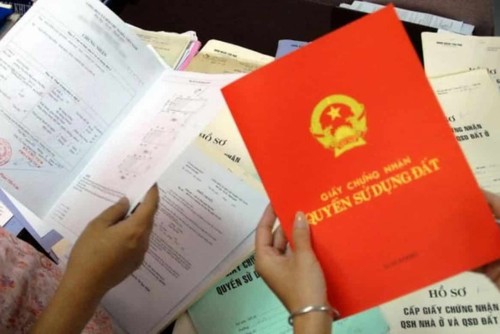
Step 9: Pay taxes, issue a pink book for each lot.
In order to issue a pink book, the investor of a residential or urban project project must fulfill financial obligations related to the project's land area, including: land use levy, land rent, taxes, and fees. , fees related to land (if any).
At this step, the investor must return the project's total pink book (or include many different pink books), summarizing which books have been converted to residential land, which have not been converted to residential land for tax payment.